
Hydroelectric power plants rely on rotating machinery to convert the energy of moving water into electricity. From compact installations supplying electricity to remote communities to large generating stations serving national power grids, turbines must operate reliably under demanding mechanical and hydraulic conditions. Bearings play an essential role in supporting rotating shafts, managing mechanical loads, and maintaining stable equipment operation.
The design and operating requirements of hydro turbine bearings can vary considerably between small and large hydroelectric facilities. Differences in turbine capacity, shaft dimensions, rotational speed, load distribution, and maintenance resources influence bearing selection and installation. Understanding these differences helps engineers choose suitable bearing arrangements for each type of power plant.
1. The Role of Bearings in Hydroelectric Power Plants
Bearings support rotating components and help maintain the alignment of turbine and generator shafts. They also manage forces generated during normal operation and changing hydraulic conditions.
Their main functions include:
- Supporting radial loads from rotating components
- Managing axial loads through thrust-bearing arrangements
- Maintaining shaft position and alignment
- Reducing friction between moving surfaces
- Supporting stable rotation
- Limiting excessive vibration and mechanical wear
Bearing performance affects the reliability of the turbine-generator assembly. A bearing problem can lead to overheating, vibration, equipment damage, and unexpected shutdowns.
Although the basic functions remain similar across different plant sizes, the engineering requirements can be quite different.
2. Bearing Requirements in Small Hydroelectric Power Plants
Small hydroelectric plants generally have lower generating capacities and more compact turbine-generator arrangements than large power stations.
They may use Kaplan, Francis, Pelton, or other turbine configurations, depending on available water head and flow conditions.
Their bearing systems are usually designed around the dimensions, loads, and operating characteristics of the specific installation.
Compact Equipment Arrangements
Smaller turbines often have relatively compact shafts and bearing housings. This can simplify installation and inspection, although limited physical space may create challenges when accessing certain components.
Bearing dimensions and support arrangements must match the equipment’s mechanical requirements.
Cost and Maintenance Considerations
Small hydroelectric facilities may operate with limited maintenance personnel and budgets.
For this reason, bearing selection often considers:
- Initial equipment cost
- Expected service life
- Ease of installation
- Availability of replacement components
- Lubrication requirements
- Inspection accessibility
A suitable bearing should provide reliable operation without creating unnecessarily complicated maintenance demands.
Operating Flexibility
Some small hydro plants experience changing water availability throughout the year. Seasonal flow variations can affect turbine loading and operating schedules.
Bearing systems must therefore be suitable for the expected operating range, including startup, shutdown, and changes in mechanical load.
3. Bearing Requirements in Large Hydroelectric Power Plants
Large hydroelectric stations contain high-capacity turbine-generator units designed to handle substantial hydraulic and mechanical forces.
Their bearing systems must support larger rotating assemblies and operate reliably over long periods.
Depending on the turbine configuration, these facilities may use several guide bearings and thrust-bearing arrangements.
Higher Mechanical Loads
Large turbines often have substantial rotating masses and significant hydraulic thrust.
Their bearings must be engineered to support the expected radial and axial loads while maintaining suitable operating clearances.
Load distribution is particularly important because uneven pressure can cause localized heating and accelerated surface deterioration.
Complex Bearing Arrangements
Large generating units may use multiple bearing locations to maintain shaft stability.
These arrangements can include:
- Upper guide bearings
- Lower guide bearings
- Turbine guide bearings
- Thrust bearings
- Specialized support bearings
Each component performs a specific function within the rotating assembly.
Advanced Monitoring Requirements
Because a bearing failure can cause substantial downtime, large power stations often use integrated condition-monitoring systems.
These systems may track temperature, vibration, shaft displacement, lubrication pressure, and other operating parameters.
Monitoring information helps maintenance teams identify developing problems and plan interventions before serious damage occurs.
4. Common Bearing Types Used in Small and Large Hydro Plants
The bearing type depends on turbine configuration, rotational speed, load requirements, lubrication arrangements, and installation design.
Journal Bearings
<AsyncImage query=”industrial hydropower turbine journal bearing cutaway engineering” aspectRatio=”16:9″ width=”100%” maxHeight={180}/>
Journal bearings support radial loads through a lubricating film between the rotating shaft and bearing surface.
They are widely used in turbine-generator applications where continuous shaft support is required.
Their performance depends on bearing geometry, shaft speed, lubricant viscosity, clearance, and operating load.
Thrust Bearings
<AsyncImage query=”hydroelectric generator tilting pad thrust bearing industrial assembly” aspectRatio=”16:9″ width=”100%” maxHeight={180}/>
Thrust bearings manage axial forces acting along the shaft.
They are particularly important in vertical-shaft installations, where they may support the weight of rotating components and hydraulic thrust.
Tilting-pad designs are used in many applications to distribute axial loads and maintain a suitable lubricant film.
Water-Lubricated Bearings
<AsyncImage query=”water lubricated hydro turbine guide bearing polymer composite” aspectRatio=”16:9″ width=”100%” maxHeight={180}/>
Water-lubricated bearings use water as the lubrication and cooling medium.
They are suitable for selected applications where compatible materials and operating conditions allow reliable performance.
Water quality, suspended particles, flow conditions, and bearing material characteristics must be considered carefully.
Specialized Composite Bearings
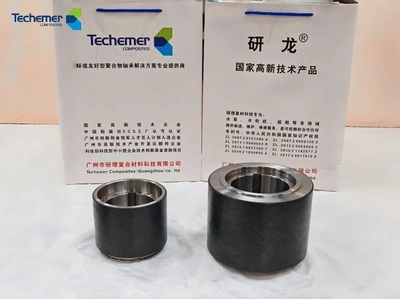
Some hydroelectric applications use engineered polymer or composite materials to meet particular requirements.
These materials may offer corrosion resistance, suitable wear properties, or compatibility with water-lubricated arrangements.
Their suitability depends on the bearing design and the loads, speeds, and environmental conditions involved.
5. Key Differences Between Small and Large Hydroelectric Plant Bearings
Although both plant types require reliable shaft support, their engineering priorities can differ.
| Comparison Factor | Small Hydroelectric Plants | Large Hydroelectric Plants |
|---|---|---|
| Equipment scale | Generally compact | Large turbine-generator assemblies |
| Bearing dimensions | Often smaller | Often larger and application-specific |
| Load requirements | Based on smaller unit capacity | May involve substantial radial and axial loads |
| Bearing arrangement | Often simpler | May include multiple guide and thrust bearings |
| Monitoring | May use basic or selected sensors | Often uses integrated monitoring systems |
| Maintenance resources | May be limited | Often supported by specialized teams |
| Replacement planning | May depend on component availability | Usually involves detailed outage planning |
| Installation | Often less complex | Can require specialized lifting and alignment procedures |
These are general differences rather than universal rules. Actual bearing arrangements depend on turbine design, operating conditions, and manufacturer specifications.
6. How Turbine Type Influences Bearing Selection
Plant capacity alone does not determine the required bearing design. Turbine type and operating characteristics are equally important.
Francis Turbines
<AsyncImage query=”Francis hydroelectric turbine runner and vertical shaft assembly” aspectRatio=”16:9″ width=”100%” maxHeight={180}/>
Francis turbines are commonly used in medium- and high-capacity hydropower installations, although they also appear in smaller plants.
Their bearing arrangements must accommodate shaft support requirements and hydraulic forces associated with the turbine design.
Kaplan Turbines
<AsyncImage query=”Kaplan hydroelectric turbine runner adjustable blades” aspectRatio=”16:9″ width=”100%” maxHeight={180}/>
Kaplan turbines are often used in low-head applications with relatively high water flow.
Their bearing systems must be compatible with the turbine’s shaft arrangement, rotational characteristics, and operating conditions.
Pelton Turbines
<AsyncImage query=”Pelton hydroelectric turbine runner buckets generator shaft” aspectRatio=”16:9″ width=”100%” maxHeight={180}/>
Pelton turbines are impulse turbines commonly used in high-head applications.
Bearing requirements depend on runner configuration, shaft arrangement, generator design, and the forces transmitted through the rotating assembly.
Selecting bearings according to the actual turbine configuration helps maintain appropriate support and operating stability.
7. Material Selection for Different Plant Sizes
Bearing materials influence wear resistance, friction, load capacity, thermal behavior, and corrosion resistance.
Small and large hydroelectric plants may use similar material categories, but the required specifications can differ.
Common materials include:
- Bronze alloys: Used in selected bearing applications because of their mechanical properties and compatibility with particular operating environments.
- White-metal linings: Common in hydrodynamic bearing designs because of their conformability and suitable running characteristics.
- Engineered polymers: Used in certain water-lubricated and corrosion-resistant applications.
- Specialized steel components: Used for structural support and other bearing elements where strength and dimensional stability are important.
Material selection should account for the bearing design, shaft surface, lubrication method, operating load, and environmental conditions.
8. Lubrication Requirements in Small and Large Hydro Plants
Lubrication protects bearing surfaces and helps control friction and heat generation.
However, lubrication system requirements can vary according to bearing size, operating speed, load, and plant design.
Oil-Lubricated Systems
Many hydroelectric turbine and generator bearings use oil-based lubrication arrangements.
These systems may include reservoirs, pumps, filters, coolers, and oil distribution passages.
Large installations may require more extensive lubrication and monitoring arrangements because of the scale and operating demands of their equipment.
Water-Lubricated Systems
Selected bearing applications use water lubrication, particularly where the materials and operating conditions are suitable.
These arrangements require attention to water quality, flow, filtration, and contamination control.
The choice between oil and water lubrication should be based on engineering requirements rather than plant size alone.
9. Installation and Alignment Considerations
Correct installation is essential for both small and large hydroelectric power plants.
Incorrect shaft alignment or bearing clearance can cause vibration, uneven loading, and excessive temperatures.
Small installations may have simpler equipment arrangements, but dimensional accuracy remains important.
Large generating units often require more extensive alignment procedures because of their longer shafts, heavier components, and multiple bearing locations.
Important installation checks include:
- Inspecting shaft and bearing surfaces.
- Measuring housing dimensions.
- Confirming radial and axial clearances.
- Checking shaft alignment.
- Verifying bearing positioning.
- Inspecting lubrication passages.
- Recording final installation measurements.
Following manufacturer specifications helps ensure that bearings operate within their intended limits.
10. Maintenance Strategies for Different Hydropower Facilities
Maintenance planning should reflect the plant’s equipment configuration, operating schedule, and available resources.
Maintenance in Small Hydroelectric Plants
Small facilities may benefit from straightforward preventive maintenance programs that focus on essential operating measurements and regular physical inspections.
Typical activities include:
- Checking bearing temperature
- Monitoring abnormal noise and vibration
- Inspecting lubricant condition
- Checking for leakage
- Reviewing shaft movement
- Recording maintenance observations
Simple, consistent inspection routines can help identify developing problems early.
Maintenance in Large Hydroelectric Plants
Large facilities may use more comprehensive condition-monitoring and maintenance management systems.
Activities can include:
- Continuous vibration monitoring
- Temperature trend analysis
- Oil sampling and laboratory testing
- Shaft displacement measurement
- Detailed bearing inspections
- Planned overhaul and replacement programs
These methods help maintenance teams evaluate bearing condition and coordinate work during scheduled outages.
11. Common Bearing Problems Across Both Plant Types
Despite differences in size and capacity, small and large hydroelectric plants can experience similar bearing problems.
| Bearing Problem | Possible Cause | Potential Consequence |
|---|---|---|
| Overheating | Insufficient lubrication or excessive load | Lubricant degradation and surface damage |
| Excessive vibration | Misalignment or rotor imbalance | Increased mechanical stress |
| Surface wear | Contamination or poor lubrication | Reduced bearing life |
| Corrosion | Moisture or unsuitable material | Surface deterioration |
| Excessive clearance | Progressive wear or incorrect installation | Shaft instability |
| Lubricant contamination | Water or foreign particles | Accelerated wear |
| Uneven load distribution | Incorrect alignment or bearing geometry | Localized damage |
Identifying the underlying cause is important. Replacing a damaged bearing without correcting the original problem may result in repeated failures.
12. Factors to Consider When Choosing Bearings for a Hydropower Plant
Whether a facility is small or large, bearing selection should begin with a clear understanding of the operating requirements.
Engineers should evaluate:
Turbine configuration: Different turbine types have different shaft arrangements and mechanical demands.
Radial and axial loads: The bearing must support the expected forces under normal and changing operating conditions.
Rotational speed: Bearing geometry and lubrication must be suitable for the operating speed range.
Lubrication method: Oil, water, or another specified arrangement must be compatible with the bearing design.
Material properties: Materials should withstand the expected wear, temperature, and environmental exposure.
Installation dimensions: Shaft size, housing geometry, and clearances must match the equipment specifications.
Maintenance accessibility: Inspection and replacement requirements should be considered during selection.
A complete engineering assessment helps prevent unsuitable bearing choices and supports long-term equipment reliability.
13. The Role of Bearing Suppliers and Technical Support
Choosing an appropriate bearing involves more than comparing dimensions or initial purchase prices.
Technical specifications, manufacturing quality, material properties, and application suitability all influence long-term performance.
Plant operators and maintenance engineers should review component drawings, load ratings, clearance requirements, lubrication recommendations, and relevant quality documentation before approving a replacement.
Techemer offers technical information on industrial bearing applications that can help professionals explore bearing requirements for hydropower equipment.
14. Future Developments in Hydropower Bearing Technology
Bearing technology continues to evolve through improvements in materials, manufacturing, lubrication, and condition monitoring.
Several developments are relevant to both small and large hydroelectric facilities.
Advanced Bearing Materials
New material combinations and engineered composites can provide application-specific improvements in wear resistance, corrosion protection, and operating characteristics.
Improved Manufacturing Accuracy
Precision machining and improved quality-control methods help produce bearing components with more consistent dimensions and surface finishes.
Digital Condition Monitoring
Sensors and monitoring software can help operators track temperature, vibration, and shaft movement. Data analysis can support earlier identification of abnormal operating conditions.
More Efficient Maintenance Planning
Condition-based maintenance allows facilities to use equipment measurements and historical trends when planning inspections and replacement work.
These developments can support improved reliability, although their benefits depend on correct application and implementation.
Conclusion
Hydro turbine bearings are essential components in both small and large hydroelectric power plants. While the fundamental purpose of supporting rotating shafts and managing mechanical loads remains the same, bearing arrangements, dimensions, monitoring requirements, and maintenance strategies can differ significantly between installations.
Small plants often prioritize practical, cost-effective bearing solutions and manageable maintenance routines. Large facilities typically require more extensive bearing arrangements, advanced monitoring, and carefully coordinated maintenance programs.
Ultimately, reliable bearing performance depends on selecting the right design, material, and lubrication system for the specific turbine. With accurate installation, regular inspection, and suitable operating practices, hydroelectric facilities of every size can maintain stable equipment performance and dependable electricity generation.