
A refrigerator is one of the most important appliances to keep operating during a power outage. Food can spoil when cooling is interrupted for too long, so having a suitable backup power system can provide valuable protection.
This refrigerator backup power guide explains what to look for when choosing a generator or portable power station, including refrigerator wattage, compressor startup demand, battery capacity, output, recharge speed, and other useful features.
Start With Your Refrigerator’s Power Requirements
The first step is to identify how much electricity your refrigerator actually needs. Check its rating label, owner’s manual, or manufacturer’s specifications.
Pay particular attention to:
- Running or rated wattage
- Voltage requirements
- Startup or surge wattage
- Any specific electrical requirements
Refrigerators vary considerably, so using the actual specifications for your appliance is preferable to relying on a generic wattage estimate.
Why Startup Power Matters
A refrigerator’s compressor cycles on and off to maintain the desired temperature. When the compressor starts, it can temporarily draw more electricity than it uses during normal operation.
This startup demand is sometimes called surge or peak power. A backup system therefore needs sufficient continuous output for normal operation and enough peak output to accommodate the compressor’s startup requirement.
A generator that meets the refrigerator’s running wattage but cannot handle its startup demand may not be suitable.
Continuous Output vs. Peak Output
When comparing generators, look at both ratings.
Continuous output indicates how much power the system can provide during normal operation.
Peak output indicates the higher amount of power that may be available temporarily for startup demands.
The GEYOTO N300 provides 300W continuous pure sine wave output and 500W peak output. The N1000 provides 1,800W continuous pure sine wave output and 3,000W peak output.
The refrigerator’s actual requirements should always be compared with these ratings before use.
Battery Capacity Determines Available Energy
For a battery-based portable power station, capacity is measured in watt-hours (Wh).
While output determines whether the generator can operate the refrigerator at a given moment, battery capacity determines how much stored energy is available over time.
The GEYOTO N300 has a 256Wh capacity, while the N1000 has a 1,024Wh capacity.
A higher capacity can provide more available energy, but actual refrigerator runtime depends on the appliance’s energy consumption, compressor cycling, environmental conditions, inverter efficiency, and other connected devices.
How to Estimate Refrigerator Runtime
A basic theoretical formula is:
Estimated runtime = battery capacity (Wh) ÷ load (W)
For refrigerators, this should only be treated as a rough estimate. The compressor does not necessarily operate continuously, and real-world losses and cycling affect energy consumption.
For a more practical assessment, consider the refrigerator’s typical energy consumption over time and allow for the generator’s conversion efficiency and any other equipment sharing the battery.
GEYOTO N300 for Compact Backup
The GEYOTO N300 is positioned as a compact “Grab and Go” portable power solution.
Its approved specifications include:
- 256Wh capacity
- 300W continuous pure sine wave output
- 500W peak output
- 550W Constant Power mode
- LiFePO4 battery
- 4,000-cycle battery life
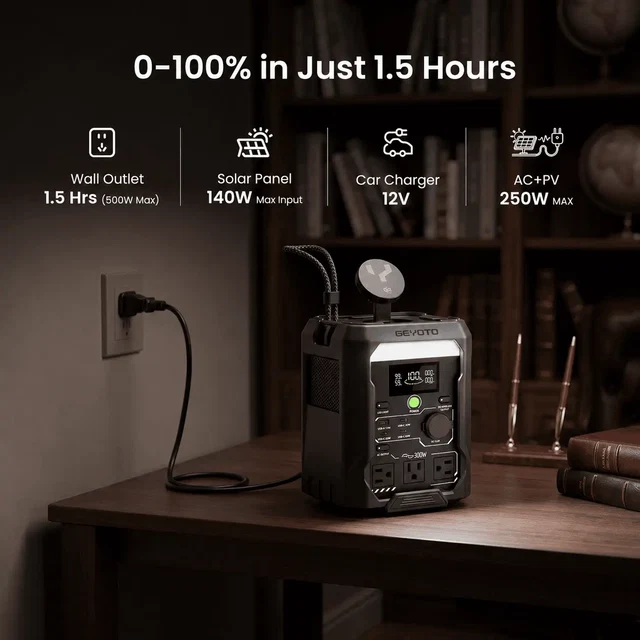
- About 1.5-hour full recharge
- 9 output outlets
- 25W wireless charging
- UPS switching of less than 10ms
The N300 is primarily designed for camping, travel, small electronics, Wi-Fi routers, laptops, lighting, and short-term outage backup. Refrigerator use depends on whether the specific appliance’s running and startup requirements fall within the system’s supported limits.
GEYOTO N1000 for Higher-Capacity Backup
The GEYOTO N1000 is positioned for higher-capacity home emergency applications, including compatible refrigerators.
Its approved specifications include:
- 1,024Wh capacity
- 1,800W continuous pure sine wave output
- 3,000W peak output
- 2,400W Constant Power mode
- LiFePO4 battery
- 4,000-cycle battery life
- 0–80% recharge in 43 minutes
- 100% recharge in 68 minutes
- 18 total ports and interfaces, including 13 output ports
- Qi2.2 25W wireless charging
- UPS switching of less than 10ms
- XT60 vehicle-support output rated at 12.6V/30A, up to 378W
Its greater capacity and output provide more flexibility for compatible household loads during an outage.
Constant Power Mode
Constant Power is another specification to understand when comparing portable power stations.
The N300 offers 550W Constant Power, while the N1000 offers 2,400W Constant Power.
This mode can provide additional flexibility for compatible loads within the specified operating conditions. It does not increase the battery’s stored energy, and higher-power operation can consume available energy more quickly.
Always verify that the refrigerator and any other connected equipment are compatible with the system’s operating limits.
Pure Sine Wave Output
Both the N300 and N1000 provide pure sine wave output.
This type of AC output is designed to provide a waveform similar to utility electricity and can be an important consideration for appliances containing motors and compressors.
Pure sine wave output does not automatically guarantee compatibility, so the refrigerator manufacturer’s requirements should still be checked.
Running Other Devices With Your Refrigerator
During an outage, you may want to power more than the refrigerator.
Possible additional loads include:
- Wi-Fi router and modem
- Essential lighting
- Phone chargers
- Laptop
- Fans
Add the running wattage of these devices to the refrigerator’s expected load and compare the combined demand with the generator’s continuous output.
Also consider startup requirements for any additional motor-driven equipment. If the refrigerator is your highest priority, disconnecting nonessential loads can help conserve available battery energy.
Recharge Speed Matters
A backup system is more useful when it can be prepared quickly for another outage.
The N300 can fully recharge in about 1.5 hours.
The N1000 can reach 0–80% in 43 minutes and 100% in 68 minutes.
Fast charging can be particularly useful when utility power returns temporarily or when outages occur repeatedly.
UPS Switching
Both GEYOTO models have a specified UPS switching time of less than 10 milliseconds.
UPS functionality can help reduce interruptions for compatible connected electronics when utility power fails. Before depending on this feature, verify the requirements and compatibility of the equipment you plan to connect.
How to Conserve Refrigerator Backup Power
Once the refrigerator is connected to a suitable backup system, energy management can help extend available runtime.
Keep refrigerator and freezer doors closed as much as possible during an outage. Avoid unnecessary opening because cold air escapes each time the door is opened.
You can also disconnect optional devices and avoid high-power appliances unless they are essential. This allows more of the stored energy to remain available for refrigeration and other priorities.
Refrigerator Generator Selection Checklist
Before choosing a backup system, review:
- The refrigerator’s running wattage.
- Its compressor startup requirement.
- The generator’s continuous output.
- Its peak output.
- Battery capacity in Wh.
- Expected outage duration.
- Other devices that will share the system.
- Available ports and connections.
- Recharge speed.
- Manufacturer compatibility and safety instructions.
Final Thoughts
The best refrigerator backup system is not necessarily the one with the highest wattage or largest battery. It is the one whose specifications match the refrigerator’s actual electrical requirements and your expected outage conditions.
The GEYOTO N300 provides 256Wh of capacity, 300W continuous output, and 500W peak output for compact backup applications. The N1000 provides 1,024Wh, 1,800W continuous output, and 3,000W peak output and is positioned for broader home emergency applications that can include compatible refrigerators.
Before connecting any refrigerator, check its running and startup requirements and compare them with the generator’s continuous output, peak capability, and available battery capacity. This approach provides a more reliable foundation for refrigerator backup planning.