
AI-generated fashion imagery has had a strange first few years in the apparel industry. It is genuinely useful for quick mood boards, early concept exploration, and marketing content that does not need to correspond to an actual, buildable garment. But a striking AI image of a jacket is not a pattern, a bill of materials, or anything a factory can produce. For brands trying to use AI for real product development rather than just inspiration, that gap has been a persistent frustration.
Closing that gap is where a connected AI and 3D fashion workflow, rather than AI used in isolation, starts to make a real difference, by tying early AI concepts to the product data and reusable 3D assets a brand actually needs to turn a design into something sellable.
The Gap Between a Nice Image and a Sellable Product
A design team can generate dozens of AI concept images in an afternoon, which feels productive right up until someone asks how any of them would actually be made. The garment in the image may have construction details that are not physically possible, proportions that do not hold up once simulated on a body, or a silhouette that has no clear path to a pattern at all.
This is the core limitation of using AI image generation in isolation: it is disconnected from the data, assets, and approval steps that turn a concept into a product a brand can actually sell. Without that connection, AI output stays stuck in the “nice to look at” category.
Connecting AI Output to Real Product Data
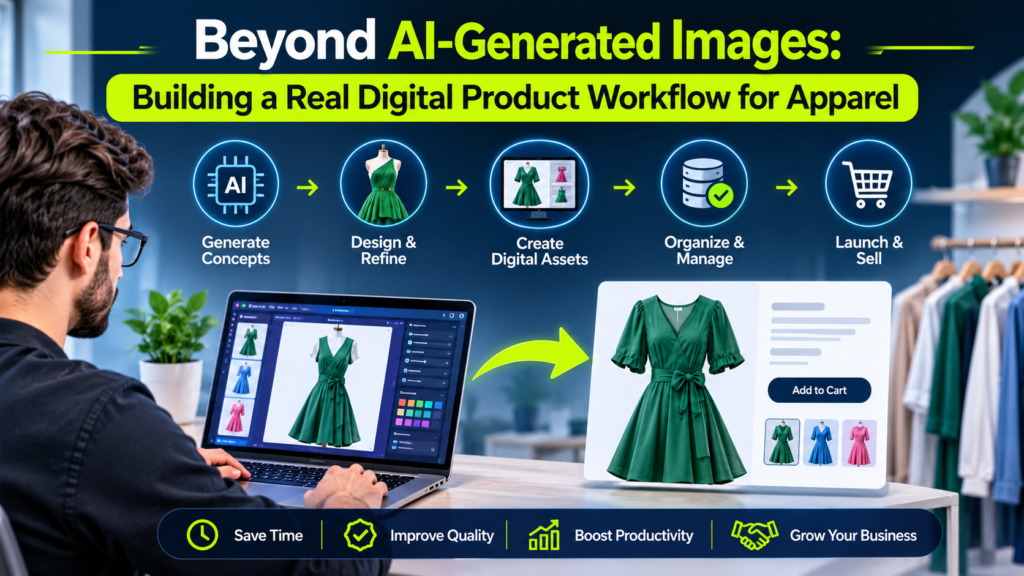
The more useful approach treats AI as one stage in a longer workflow rather than the whole workflow. An AI-generated concept gets evaluated, and the ones worth pursuing get converted into real, validated 3D garments, built from actual patterns and actual digital fabric assets rather than a static image. From there, the digital garment can move through the same review, costing, and production-preparation steps a traditionally developed style would go through.
Style3D’s approach to this, described in its solution for a connected AI and 3D fashion workflow, is built around exactly this idea: linking AI outputs to approved product data, reusable 3D assets, and the enterprise workflows a fashion team already depends on for development, marketing content, and production-related tasks. The emphasis is on connection rather than replacement, AI accelerates the early concept stage, and 3D and PLM-style structures carry the design through to something that can actually be produced.
Measuring Whether the Workflow Is Actually Working
It is easy for a team to feel productive simply because a lot of AI imagery is being generated, which is exactly why that is the wrong thing to measure. A more useful indicator is how many of those AI concepts actually survive the trip into a validated, producible 3D garment, and how much faster that conversion happens compared with starting a style from a blank page. A workflow generating hundreds of attractive images that never become real product data is not actually solving the gap this approach is meant to close.
Tracking a small number of concrete numbers, concepts generated versus concepts converted to validated garments, and development time for an AI-assisted style versus a traditionally started one, gives a far more honest picture than simply counting how much AI-generated content a team has produced in a given month.
Why the Marketing Team Cares Too
This kind of connected workflow is not only a design department concern. Marketing teams increasingly want product imagery before a physical sample exists, for early campaign planning or e-commerce previews. If the only available option is unconnected AI imagery, there is a real risk of showing customers something that will not match the final product, creating returns and complaints down the line.
When AI concepts are tied to validated 3D garments instead, the imagery generated for marketing can be traced back to a real, producible product. That alignment between what is shown and what ships matters more as more of the shopping experience moves to digital previews and virtual try-on style content.
What to Ask Before Adopting AI Into Product Development
Before leaning on AI tools for apparel development, it is worth asking a few grounding questions. Does the AI output connect to anything structured, like a pattern or a bill of materials, or does it exist only as an image? Can a concept generated with AI assistance move into a review and approval process the same way a traditionally designed style would? And does the resulting workflow reduce the number of physical samples needed, or does it just add an extra, disconnected step at the very beginning of development?
Teams that can answer these clearly tend to get real production value out of AI, rather than a growing folder of concept art that never becomes a product.
Style3D’s article on AIGC-powered 3D software goes deeper into this specific intersection of generative AI and 3D simulation, for readers who want more detail on where this technology is headed next.
Treating AI as a Stage, Not a Shortcut
The brands getting genuine value from AI in apparel development are not the ones expecting it to replace design and technical teams. They are the ones using it to speed up the earliest, most exploratory stage of concept creation, while relying on 3D simulation, digital fabric assets, and established review processes to carry a concept the rest of the way to something sellable. That combination, fast ideation paired with a workflow that can actually validate and produce the result, is where AI starts contributing to real product development instead of just populating a mood board.